(A No-Nonsense Guide From Someone Who Has Slept On All of Them)
Let’s be honest. Most people spend more time researching which blender to buy than they do thinking about what they’re resting their head on for eight hours a night. That’s roughly a third of your entire life — pressed face-first into whatever the internet told you was the “best pillow” with five stars and free two-day shipping.
You deserve better than that. And your neck definitely does.
After years of testing, reviewing, and developing genuinely strong opinions about pillow construction, I’ve boiled it down to the essentials. Here is what actually separates a great pillow from an expensive mistake.
1. Spinal Alignment: The Non-Negotiable Foundation
Everything starts here. A pillow’s single most important job is to keep your head, neck, and spine in neutral alignment while you sleep. Full stop.
Poor cervical posture during sleep places excessive amounts of stress on cervical spine structures — which can increase waking symptoms including neck and shoulder pain, tension headaches, and muscular stiffness. In other words, the wrong pillow isn’t just uncomfortable. It’s actively working against you every single night.
The research on this is clear. A systematic review published in the European Journal of Integrative Medicine found moderate evidence that a pillow height between 7 and 11 centimeters yields the highest comfort ratings, reduces cervical and cranial pressure, reduces cervical muscle activation, and promotes optimal spinal alignment. That’s not marketing copy — that’s peer-reviewed science telling you that loft matters, and it matters in specific, measurable ways.
What does this mean practically? It means your pillow needs to match your sleep position. A pillow that works beautifully for a side sleeper can be a neck-wrecking disaster for a stomach sleeper, and vice versa. Loft and firmness are not one-size-fits-all — they are deeply personal, and any pillow review site worth reading (hi) will tell you exactly which sleeper a given pillow is designed for.
2. Fill Material: Where Most Pillows Win or Lose
The fill inside your pillow determines almost everything else — the feel, the support, the temperature regulation, the longevity, and yes, what you’re breathing in all night long.
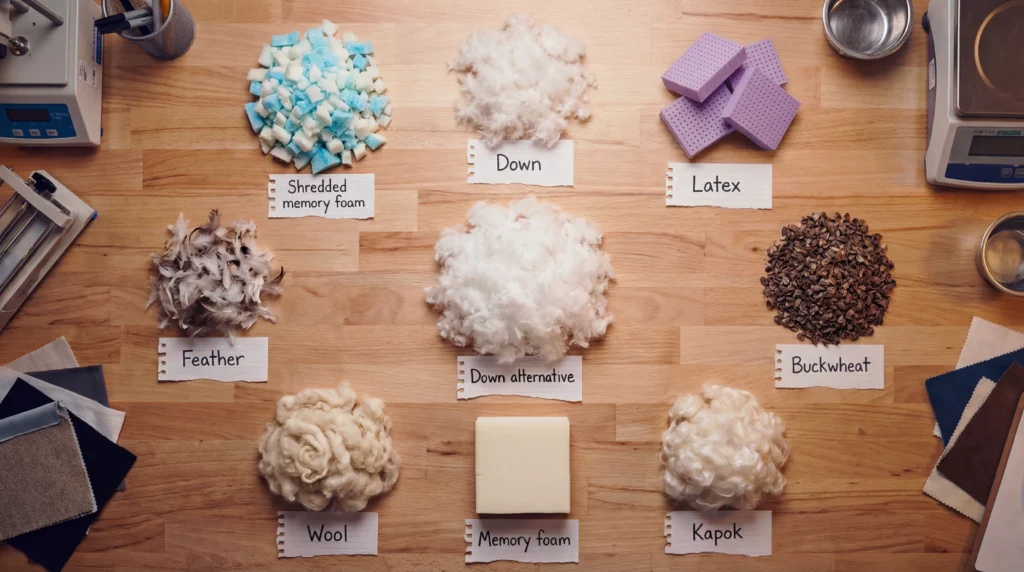
Here’s a quick field guide to what’s actually out there:
Latex is the gold standard for support and durability. Research shows that latex pillow material currently has the greatest evidence for improving sleep comfort and quality, decreasing neck pain, and improving overall function. It’s responsive, breathable, and doesn’t trap heat the way foam does.
Hypoallergenic premium down alternative is my personal recommendation for the majority of sleepers — it delivers that classic, cloud-like softness without the allergens of real down, without the ethical concerns of feathers, and without a single molecule of off-gassing chemical funk.
Memory foam deserves a frank conversation. The contouring support is real and beneficial for some sleepers — but so is the smell. Research published in Chemosphere found that memory foam products emit volatile organic compounds (VOCs) including 2-propanol, acetone, chloromethane, and toluene, with emission rates peaking sharply in the first day after use. According to the Sleep Foundation, some people may experience eye, nose, and throat irritation from VOCs — which is a meaningful concern when your face is six inches away from the source for the better part of a decade. If you’re committed to foam, look for CertiPUR-US certified options, which are independently tested for lower chemical emissions.
Buckwheat is the dark horse of the pillow world — firm, fully adjustable, exceptional airflow, and essentially lasts forever. Not for the faint of heart (or light of sleep), but a legitimate contender for the right sleeper.
Shredded fills (latex or foam) offer adjustability through a zippered closure, which sounds great in theory. In practice, loose fill migrates, clumps, and creates an uneven sleep surface over time. The adjustability is real — the long-term consistency is not always.
3. Fill Migration and Structural Integrity: The Problem Nobody Talks About Enough
You know what I’ve never seen in a pillow advertisement? A photo of what the pillow looks like at 3 AM after someone has been tossing and turning on it for four hours.
Because the dirty secret of the pillow industry is that fill moves. Single-chamber pillows with loose fill — whether that’s shredded foam, shredded latex, or traditional down — are susceptible to migration throughout the night. The filling bunches, the loft becomes uneven, and the neck support you paid for quietly disappears while you’re unconscious and unable to do anything about it.
The solution to this problem is structural design, not marketing language. Multi-chamber construction — where an inner core is separated from an outer layer by design — keeps fill where it belongs. Solid cores (latex or quality foam) don’t migrate at all by definition. When you’re evaluating a pillow, ask yourself: what is physically preventing this fill from moving? If the answer is “nothing except gravity and hope,” that’s relevant information.
4. Temperature Regulation: The Silent Sleep Killer
Sleeping hot is one of the most underrated enemies of quality sleep, and your pillow is either helping or hurting.
Research identifies a cooling surface as one of the key pillow parameters that can meaningfully improve sleep quality. This isn’t about luxury — it’s about the basic sleep science fact that your core body temperature needs to drop to initiate and maintain deep sleep. A pillow that traps heat works against that process all night long.
Memory foam is the most notorious offender here. Its dense, closed-cell structure absorbs and retains body heat rather than dispersing it. Latex, buckwheat, and quality down alternative all outperform foam in breathability for this reason. If you regularly find yourself flipping your pillow to the cool side in the middle of the night, your pillow is losing the temperature regulation battle — and so are you.
5. Hypoallergenic Properties and Washability: Because Pillows Are Disgusting
I say this with love: your pillow is one of the most bacteria-rich objects in your home. Dust mites, dead skin cells, sweat, and over time, mold — all of it accumulates in a pillow that isn’t properly maintained. The fill material you choose determines how resistant your pillow is to this reality, and how easy it is to clean when resistance fails.
Hypoallergenic fills — down alternative, latex, wool — offer meaningful protection against dust mites and allergens. Research confirms that appropriate pillow use can support spinal alignment, reduce muscle strain, and improve sleep — but only when paired with the right maintenance habits that keep the pillow performing as designed.
Washability is a practical consideration that gets wildly underweighted in most pillow reviews. Memory foam — solid or shredded — generally cannot be machine washed. The fill can only be spot cleaned. For something that’s touching your face every night, that matters. Down alternative and many latex options are far more forgiving from a hygiene standpoint, which is another meaningful point in their favor beyond just comfort.
6. The Return Policy: Your Last Line of Defense
Even after reading everything above and making the most informed pillow purchase of your life, there remains one uncomfortable truth: you will not actually know if a pillow works for you until you’ve slept on it for two or three weeks.
A generous, no-hassle return policy isn’t a luxury — it’s a signal that a brand is confident enough in their product to let you find out the truth. A return policy with a steep restocking fee, on the other hand, is a brand that knows the post-purchase experience might not match the pre-purchase promise.
Read the return policy before you read the marketing. Every time.
The Bottom Line
A great pillow keeps your spine aligned, maintains its structure through the night, regulates temperature, uses clean materials you feel good about breathing next to, and can actually be washed when the inevitable happens. It works specifically for your sleep position, not generically for everyone.
It does not need to be the most reviewed pillow on the internet. It does not need a zipper to be innovative. It does not need to smell like a chemistry lab to prove it’s doing something sophisticated.
Sleep is not a passive activity — it’s the most important recovery tool your body has. The pillow you choose is either supporting that recovery or quietly undermining it, one night at a time.
Choose like it matters. Because it does.
The Pillow Snob, Sleep and Pillow Expert
Further Reading & Research:
- Effect of Pillow on Pain, Disability and Sleep Quality — PubMed Systematic Review
- Effect of Different Pillow Designs on Sleep Comfort, Quality & Spinal Alignment — ScienceDirect
- VOC Emissions from Memory Foam: Consumer Health Risk Evaluation — ScienceDirect/Chemosphere
- Is Memory Foam Toxic? — Sleep Foundation
- Individualized Optimal Pillow Height for Side Sleepers — PubMed